Vibe Coding vs. Hiring an App Development Agency: What Does It Really Cost to Build a Mobile App?
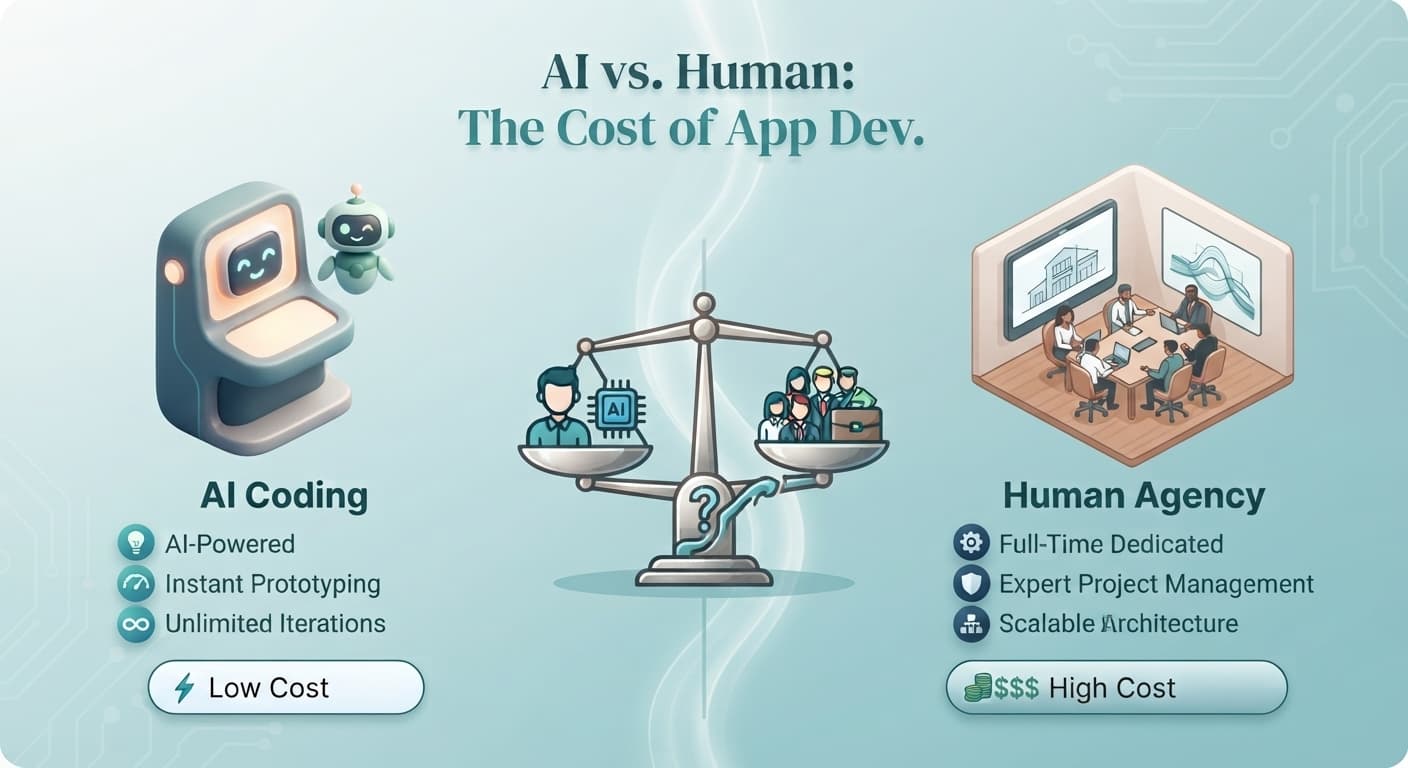
You Can Build a Mobile App With AI. But Should You?
AI development tools have changed the economics of building an app. A founder with no coding background can now build surprisingly far without hiring a single developer. But a prototype and a production application are different things. The real question isn't whether AI can build your app — it's which approach actually makes sense for your product, at its current stage.
The cheapest way to write the code isn't always the cheapest way to launch the product.
Our Example: A Mobile Booking App
To make this a fair comparison, we'll use one fixed scope throughout: a mobile booking app for a service business, with a customer-facing app, a business-management side, and the backend that connects them.
Option A: What Would It Cost to Vibe Code This App?
The path looks something like this: idea, AI prototype, frontend, backend, database, authentication, payments, notifications, testing, then the app stores. Each step is doable with today's AI tools — the question is what it actually costs to get through all of them.
Direct costs typically include: AI coding tools, hosting, a database, API usage, payment processing setup, notification services, an Apple Developer account, a Google Play Developer account, and a handful of other small SaaS tools.
Vibe Coding — Direct Cash Cost
$150–$1,000+
Tools, hosting, APIs, and store fees — before usage overages or your time.
Agency — Typical U.S. Range
$30,000–$75,000+
Illustrative U.S. market benchmark for this scope, not a quote.
The Costs the Subscription Price Doesn't Show
The sticker price is rarely the real price. These are the ones people run into most:
Your Time
150–250 hours of learning, debugging, and rebuilding — roughly 4 to 6 full work weeks for one person.
Token & Usage Limits
Most AI coding tools cap how much you can use each month. Burn through it mid-project and you either wait for the reset or pay for extra capacity — a cost the subscription price doesn't show.
Redoing the Same Feature
It's common to rebuild a feature or bug fix more than once when the AI doesn't get it right the first time. Every redo adds hours you didn't budget for.
Avoiding “AI Slop”
AI-generated interfaces have a recognizable, generic look. Getting past it so the product feels trustworthy often means hiring a designer or spending real extra hours polishing it yourself.
Security Falls on You
Without a technical background, real vulnerabilities can slip through unnoticed until they're a problem — worth an explicit review before real users touch the app.
If security is the part you're least confident about, the AI App Security Checklist walks through exactly what to check before real users touch your app.
The Real Formula
Tools + Infrastructure + Services + Time + Redos + Overages = Real Vibe-Coding Cost
Option B: What Would an Agency Charge for the Same App?
There's no universal agency price — scope, complexity, location, team composition, technology, and support can all move the number substantially. As an illustrative U.S. market benchmark for this exact scope, a production-oriented MVP like this typically falls in the $30,000–$75,000 range. More complex apps can move well beyond it.
That price isn't just for writing code. Here's what it's actually paying for:
Discovery
Requirements and product planning.
UX/UI
User flows and interface.
Architecture
Technical structure.
Development
Mobile and backend.
Integrations
Payments, APIs, notifications.
QA
Testing and bug fixing.
Security
Auth, permissions, data handling.
Deployment
Production and app stores.
Project Management
Coordination and delivery.
You're not paying an agency simply to write code. You're paying a team to take responsibility for getting the product from idea to launch.
Vibe Coding vs. Agency, Side by Side
A good agency can cover every row below well — but the quality still depends on the agency and the scope, the same way vibe-coding outcomes depend heavily on how carefully it's done.
| Vibe Coding | App Development Agency | |
|---|---|---|
| Direct cash cost | Low | ~$30k–$75k+ |
| Prototype speed | Very high | High |
| Your time | High | Lower |
| Technical responsibility | You | Agency |
| UX expertise | You + AI | Professional team |
| Architecture | You + AI | Experienced team |
| Security | Your responsibility | Part of the process |
| Testing | Your responsibility | QA process |
| App Store launch | You | Agency can handle |
| Maintenance | You | Can be contracted |
| Rework risk | Depends on implementation | Depends on agency and scope |
When Vibe Coding Is Actually the Better Choice
- You're validating an idea, not launching a finished product yet
- You need a prototype quickly to show investors or early users
- The app is relatively simple
- You have some technical ability, or genuinely enjoy learning it
- You can tolerate experimentation and the occasional dead end
- You're not yet handling sensitive customer data
- You need to find out whether people actually want this first
If you're still proving the idea, spending tens of thousands on a production build may be the wrong first move.
When Professional Development Starts Making More Sense
The equation changes once:
- Real customers depend on the app working
- Payments are involved
- Security genuinely matters
- Multiple user roles exist
- Complex integrations are required
- The backend needs to hold up under real traffic
- You need both iOS and Android done properly
- You don't want development to become a full-time job
- The cost of a mistake is high
- Someone needs to maintain it long-term
The more expensive a mistake becomes, the more valuable professional development becomes.
The Cost Nobody Includes in the AI Subscription
The risk isn't that AI can't build the app — it's that early shortcuts can get expensive once the product actually grows. Not every vibe-coded project follows this path, but it's common enough to plan around:
Fast Prototype
More Features
Technical Shortcuts
Bugs / Architecture Problems
Rework
Higher Total Cost
Low development cost doesn't always mean low total product cost.
You Don't Have to Choose One or the Other
You can use AI to prove the idea cheaply, then bring in professionals once the cost of technical mistakes starts to outweigh the savings:
Idea
Vibe Code
Validate
Professional Review
Fix / Rebuild Where Needed
Launch
Grow
Which Approach Makes Sense for You?
Choose vibe coding if:
You're proving the idea and can handle the technical responsibility yourself.
Choose an agency if:
You're building a serious commercial product and want professionals responsible for execution and launch.
Choose the hybrid approach if:
You've already built the first version with AI and want to turn it into a production-ready product.
What Happens After the App Is Built?
Whichever path you take, building the app is only half the job. Launch, analytics, a landing page, SEO, app store optimization, paid advertising, lead generation, conversion optimization, maintenance, user feedback, and product iteration all come after. A finished app isn't automatically a successful app — it still has to be launched, then grown.
So, Which One Should You Choose?
If you're still validating, vibe code first. If you're ready for a serious commercial launch, consider professional development. And if you've already built something, don't automatically throw it away — assess it first. The right decision depends less on whether AI or an agency is “better” and more on your product's stage, its complexity, your technical ability, and the cost of getting it wrong.
Use AI to move faster. Use experienced professionals when the cost of getting it wrong becomes too high.
Have an AI-built project you're not sure is ready?
Send us what you've built. We'll review where the project stands, identify the biggest blockers, and give you a clearer idea of what it would take to get it ready for launch.